Quaternary • Pallet Patterns • DC Compliance
Quaternary Packaging 101 — Pallet Patterns That Pass DC Checks
From Ti–Hi to trailer cube: stack, stabilize, and label so your loads sail through receiving.
- No overhang. Flush corners, clamp-safe faces.
- Scanner-clean labels. SSCC on two sides, quiet zones intact.
- Clamp-safe stability. Base-lock wrap, corner boards, top caps.
Introduction
This guide shows how to choose patterns, set Ti–Hi, and stabilize loads so they pass DC checks the first time.
TL;DR — Quaternary Packaging (Unit-Load) Wins
- Zero overhang. Target 0 mm; absolute tolerance ±6 mm. Corners should read as one straight vertical line.
- Choose pattern by risk: Column for crush (rigid/dense), Interlock for wobble, Pinwheel/Split for low-COF (glossy/slippery). Keep a backup pattern one Hi lower.
- Set Ti–Hi to the site window. Fit Ti flush on the pallet perimeter; cap Hi to DC limits (often ~62–72 in) and case strength (BCT/ECT).
- Base-lock + finish right. Run ≥2 film courses through deck boards, spiral with 30–50% overlap, and neck-down band the top plane. Add boards + top cap when Hi ≥ 5 or mixed SKUs.
- Labels that scannability first time. SSCC/GS1-128 on two adjacent faces at scan height, bars vertical; quiet zones clean; spot grade ANSI ≥ C.
- Declare what you ship. Record measured L×W×H and true gross weight (pallet + film + boards/cap + cases) within ±1% on pallet card & BOL.
- Ship with proof. Attach a Pass Packet: Layer-1/2 photos, wrap map (film, pre-stretch, revs, bands/straps), label close-ups, and dimensions/weight.
Quick Start — The 80/20 of Passing DC Checks
If you only do three things: pick the right pattern, eliminate overhang, and base-lock your wrap. Everything else is optimization.
Ti–Hi at a Glance
Ti = cases per layer. Hi = layers high.
Units per pallet = Ti × Hi.
- Choose Ti to fit the pallet footprint (48×40 or 1200×800).
- Set Hi by crush strength + DC height limit.
- Document:
SKU • Ti–Hi • total cases • gross wt.
Rule: If stability or scanability suffers at your target Hi, drop one layer and pass first time.
Golden Rules (Always True)
- Zero overhang. Underhang ≤ 6 mm, target 0.
- Consistent footprint. Flush corners; no mushrooming.
- Two-side SSCC. Quiet zones clean, picket-fence orientation.
- Base-locked wrapping. 2–3 courses through deck boards.
- Declare reality. Measured L×W×H and gross weight on BOL.
Pattern Chooser (Mini-Flow)
- Measure case L×W. Square-ish or rectangular?
- Select pallet. 48×40 (GMA/CHEP/PECO) or 1200×800 (EURO).
- Pick pattern.
- Rigid/dense: Column
- Wobbly/slippery: Interlock / Brick
- Square-ish/low COF: Pinwheel / Split-pinwheel
- Set wrap spec. Base-lock, overlap 30–50%, neck-down top band.
- Photo check. Layer 1, Layer 2, front/side labels, base lock.
Keep a backup pattern on file for seasonal density or liner changes.
Pallet & Case Fundamentals
Lock the basics before you chase cube. Get the pallet right, spec the case right, and DC checks become routine.
Pallet Standards (Pick Your Footprint First)
- North America: 48×40 in (GMA/CHEP/PECO). Most DCs assume this.
- Europe: 1200×800 mm (EURO). Also 1200×1000 mm for DIY/industrial.
- Specials: Beverage & club variants; half/quarter pallets for displays.
- Spec the deck: 4-way entry; top-deck board gaps < 10 mm for small-case stability.
Rule: choose pallet → design Ti to land flush on all four edges. No over/underhang.
Case Basics (Strength, Orientation, Compression Paths)
- Outer dims drive Ti: Use true packed OD (board + bulge), not flat CAD.
- Strength by route: ECT vs Burst—ECT for pallet stacks, Burst for parcel abuse.
- Flute & wall: E for clean print/light loads; B for tougher routes; BE/BC for dense SKUs.
- Compression path: Keep strongest panels vertical; avoid weak seams at corners likely to take impacts.
- Orientation marks: Up arrows / clamp-safe faces on graphics + in SOP.
If bottom row crushes in storage, raise ECT or move to double-wall before you touch the pattern.
Trailer & Container Reality
- Domestic 53’: Height windows vary by customer (often 62–72 in per unit load). Confirm before setting Hi.
- Ocean 40’ HC: Humidity & longer vibration → favor interlock or boards/top-cap on tall loads.
- Clamp handling: Grocery/bev DCs may clamp. Use flush faces, no overhang, and note Do Not Clamp where applicable.
- Railcar turns & rough handling: Add straps (poly/steel per weight) and edge protectors to stop bloom.
- Declared truth: Measured L×W×H & gross wt. must match BOL—avoid reweighs and accessorials.
Photo the load on the dock: front, side, top, and a close-up of base-lock wraps. Add to your Pass Packet.
Pattern Playbook — Pick by Geometry, Friction & Route
Use the right stack for the case you have. Start with Column for crush, switch to Interlock for lateral stability, reach for Pinwheel when faces slip, and deploy alternates to kill wobble without killing Ti.
Column Stack
Max compression • Rigid cases • Dense SKUs
- When to use: High BCT/ECT cases, heavy/dense goods, short routes, tight cube goals.
- Fit: Rectangular cases with good panel stiffness; clear, flush corners.
- Pros: Best top-load capacity; simple Ti; fast stacking.
- Cons: Poorest side stability; blooms on turns if wrap is weak.
- Typical Ti (48×40): Common grids that land flush (e.g., 10, 12, 16) depending on case L×W.
Stability adders: Corner boards + top cap if Hi ≥ 5; increase base-lock wraps.
Interlock / Brick-Layer
Better lateral stability • Broadly forgiving
- When to use: Wobbly, tall/narrow cases; low COF liners; longer, rougher routes.
- Fit: Most case aspect ratios (L:W between ~1.2:1 and 1.8:1) adapt well.
- Pros: Side stability; resists shear in linehaul vibration.
- Cons: Slight compression penalty vs Column; Ti may drop by one in some footprints.
- Typical Ti (48×40): Often the same as Column, but accept one-lower Ti if corners don’t land flush.
Tip: Keep case orientation marks in SOP so graphics face “scan sides.”
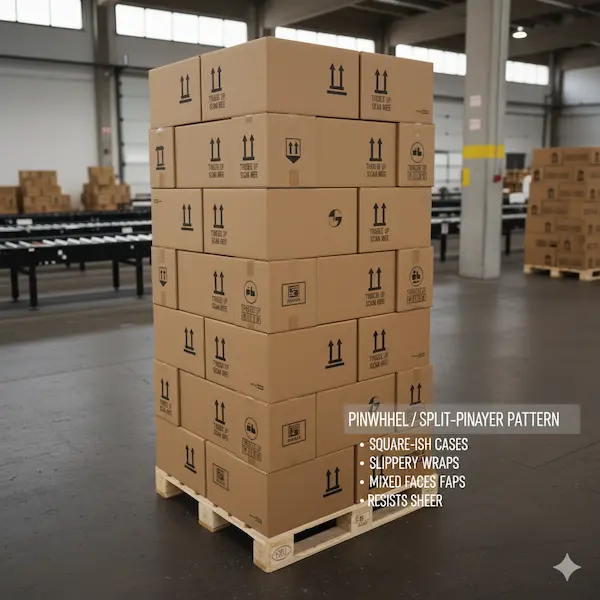
Pinwheel / Split-Pinwheel
Square-ish cases • Slippery wraps • Mixed faces
- When to use: Square/near-square cases; low friction (high-gloss or film-wrapped); picture-frame perimeters.
- Fit: Case L≈W; moderate Hi (3–6) or where corner-locking matters.
- Pros: Excellent edge locking; limits perimeter slide.
- Cons: Can reduce Ti; more complex to teach without a diagram.
- Typical Ti: Slightly lower than Column/Interlock for the same case footprint.
Variant: Split-pinwheel mixes a pinwheel perimeter with a simple center pack to recover Ti.
5-4 / 7-5 Alternates
Near-square cases • Kill wobble, keep cube
- When to use: Rocking at target Hi; case edges not lining flush on every layer.
- Fit: Cases nearing square; slight length/width mismatch to pallet perimeter.
- Pros: Tames wobble with minimal Ti loss; easy to train with layer photos.
- Cons: Counting errors without pallet cards; requires clear layer-by-layer visuals.
- Typical Ti: Alternates give the same average Ti across two layers (e.g., 5 then 4 → avg Ti 4.5).
SOP add: Print Layer 1 / Layer 2 photos on the pallet card to prevent mis-builds.
Mixed-Case Strategies
A/B alternating • Picture-frame perimeter • Layer breaks
- When to use: Small order quantities per SKU; cluster-pick DCs; visual merchandising priorities.
- Fit: Perimeter “picture frame” of the stiffer SKU + inner blocks of the softer SKU.
- Pros: Preserves perimeter stability; speeds receiving and putaway mapping.
- Cons: Counting/traceability risk without placards and slip sheets.
- Controls: Slip sheet between SKUs; layer placards; 2-side pallet card with map.
Labeling: Ensure SSCC remains on two adjacent faces with quiet zones intact, regardless of mix.
Choosing Between Two “Good” Patterns
- If bottom-row crush risk: Prefer Column + boards/top-cap over Interlock.
- If lateral wobble at Hi: Prefer Interlock or 5-4 / 7-5 alternates over Column.
- If faces slip (gloss/film): Prefer Pinwheel or Split-pinwheel; keep Ti within DC height.
Pattern Selection Matrix
Feed in case geometry, friction, strength, and pallet footprint. Get back your top 3 pallet patterns with Ti–Hi and cube notes.
Inputs (What You Know)
- Case L×W×H (packed OD) — use measured dimensions, not flat CAD.
- Weight / density class — light / medium / dense.
- Friction (COF) — low (gloss/film), medium (SBS), high (kraft).
- Strength — ECT/BCT target, wall build (E, B, BE/BC).
- Pallet footprint — 48×40 (GMA/CHEP/PECO) or 1200×800 (EURO).
- Route & handling — clamp? long linehaul? humid/cold?
- DC limits — max unit height and load weight.
If any input is unknown, assume conservative values and validate with a pilot pallet.
Logic (How We Choose)
- Fit to perimeter: maximize Ti with zero overhang.
- Stability vs compression: Column for crush; Interlock for wobble; Pinwheel for slip.
- Set Hi: min(DC height window, BCT at target stack, handling risk).
- Wrap spec: base-lock, total revolutions, neck-down band, boards/top cap rules.
- Label plan: SSCC on two scan faces at DC height window.
Always keep a backup pattern one Ti lower or one Hi lower for quick swaps.
Outputs (What You Get)
- Top 3 patterns — Column / Interlock / Pinwheel (as applicable).
- Ti–Hi — cases per layer and layers high that meet DC limits.
- % Trailer cube — estimated utilization at given Ti–Hi.
- Wrap map — film, pre-stretch, revolutions, bands, strap count.
- Controls — corner boards, top cap, slip sheets, mixed-SKU placards.
Deliverables include Layer 1/Layer 2 photos and a printable pallet card.
| Rank | Pattern | Why It Fits | Ti–Hi | % Trailer Cube* | Controls |
|---|---|---|---|---|---|
| #1 | Column | Rigid case • high BCT • flush perimeter on 48×40 | 12 × 5 | ~87% | Boards + top cap if Hi ≥ 5; base-lock wrap |
| #2 | Interlock | Tall/narrow wobble • needs lateral stability | 12 × 4 | ~80% | Base-lock wrap; neck-down band; strap mid-height if dense |
| #3 | Split-Pinwheel | Square-ish cases • low COF/gloss faces | 10 × 5 | ~78% | Slip sheet between layers; picture-frame perimeter |
*Cube is indicative; confirm with measured pallet L×W×H and trailer load plan.
Edge Cases & Overrides
- Tall & narrow: cap Hi early; Interlock; add mid-height strap.
- Bulge-prone contents: Column + boards/top cap; reduce Hi; thicker film.
- Very dense SKUs: Column; double-wall cases; increase deck board wraps.
- Low COF (slippery): Pinwheel or Split-pinwheel; consider anti-slip sheets.
- Clamp handling: Zero overhang, flat clamp faces, SSCC on scan sides.
DC Compliance Checks — What Receiving Really Looks For
Pass first time by matching the spec in four areas: dimensions, stability, labels, and documentation.
Dimensions & Overhang
- Over/underhang: Target 0 mm; absolute max ±6 mm. Corners must appear as one vertical line.
- Unit height: Stay within the customer’s window (e.g., 62–72 in). Declare measured L×W×H on pallet card & BOL.
- Footprint consistency: Same Ti every layer; no mushrooming or picture-frame gaps unless specified.
If any layer breaks perimeter flush, drop Ti or switch to Interlock/Split-pinwheel.
Stabilization (Wrap • Boards • Caps • Straps)
- Base-lock wrap: 2–3 courses through deck boards before spiraling up; 30–50% overlap; neck-down band at the top.
- Corner boards & top cap: Required for Hi ≥ 5, mixed SKUs, or glossy/low-COF cases.
- Strapping: Poly/steel per density; mid-height strap on tall & narrow loads; protect under strap with edge guards.
- Slip sheets: Between SKUs and where anti-slip is needed; keep edges flush with the perimeter.
Record a wrap map: film type, pre-stretch %, total revolutions, bands, straps.
Labeling (SSCC/GS1-128) & Scanability
- Two adjacent faces: SSCC/GS1-128 labels placed at DC scan height; picket-fence orientation.
- Quiet zones clean: No film glare, straps, or graphics invading the barcode quiet zone.
- Placards for mixed pallets: Layer placards with SKU, qty, layer #, Ti; 2-side pallet card with full map.
- Grade: Aim ANSI ≥ C. Reprint if lower in weekly spot checks.
If wrap glare is unavoidable, apply labels to a clean placard after wrapping.
Height/Weight Limits & Handling Nuance
- Gross weight: Declare pallet + film + boards + cap. Accuracy ±1%.
- Clamp handling: Zero overhang; flat clamp faces; apply “Do Not Clamp” only when specified.
- Route climate: Humid/long routes → favor Interlock, thicker film, or lower Hi.
- Safety marks: Up arrows, center of mass (if off-center), and no step on top caps if needed.
Adjust Hi seasonally when liners or contents soften in humidity/heat.
Photo Proofs (Attach to Pass Packet)
- Front & side showing labels at scan height (close-ups of barcodes).
- Top view showing pattern closure & neck-down band.
- Base-lock detail through deck boards; strap & edge-guard close-ups.
- Layer 1 and Layer 2 photos for training & audit.
Name files with SKU_Lot_Ti-Hi_View_Date for quick retrieval.
Paste-Ready DC Spec
Over/Underhang: target 0 mm; max ±6 mm. Labels: SSCC/GS1-128 on two adjacent faces at DC height; ANSI ≥ C; quiet zones clear. Wrap: base-lock (≥2 courses through deck boards), 30–50% overlap, neck-down top band; boards + top cap for Hi ≥ 5. Declared: measured L×W×H and gross weight ±1% on pallet card & BOL. Photos: front, side, top, base-lock, and layer photos attached to Pass Packet.
Validation & Pre-Ship Testing
Prove the pallet before you book the truck. Small, repeatable checks stop DC reworks and claims.
Quick Stability Checks (Shop-Floor)
- Wobble test: Two-hand 45° push on two adjacent corners; load must rebound without walking.
- Edge kick: Light boot tap on perimeter case; no slide, no shear of wrap.
- Corner line: Visual—single vertical line down all four corners (no bloom).
- Label scan: Handheld scan on both faces; ANSI est. ≥ C (spot check).
If any check fails, drop Hi by one or switch to Interlock and rewrap with base-lock.
Transit Simulation (Essentials)
- Compression: Simulate top load to route stack height (Hi at destination); inspect for bottom-row crush.
- Vibration: Random vibe to route duration; watch for label scuff and perimeter walk.
- Tilt/impact: Clamp/tilt as applicable; confirm corner boards and neck-down band hold the top plane.
- Climate: Pre-condition liners/film to worst-case RH/°C before tests.
Document film, pre-stretch %, total revolutions, straps, and any anti-slip sheets in the wrap map.
“Pass Packet” (Attach to BOL)
- Pattern set: Primary + backup (Layer-1 / Layer-2 photos).
- Ti–Hi & dims: Measured L×W×H and gross weight (±1%).
- Wrap map: Film, pre-stretch, revolutions, neck-down band, straps, corner boards, top cap.
- Labels: SSCC/GS1-128 proofs (two faces) with quiet zones clear.
- Photos: Front, side, top, base-lock close-up, strap/edge-guard, label close-ups.
- Sign-off: Name/date of approver; re-qual trigger notes.
File the packet in the SKU’s BOM/SOP and email to consignee traffic before pickup.
No Lab Yet? Run This DIY Set
- Compression stand-in: Stack known weights (or sandbags) to destination Hi for 24 h; inspect corners/panels.
- Vibe surrogate: Short courier loop or vetted shaker for 10–15 min; recheck corner line and label scuff.
- Tilt proxy: Carefully lift one pallet stringer with pry bar/cribbing ~25–30 mm; load must not migrate.
- Retest after change: Any change in case, pattern, film, Hi, or label plan triggers re-qual.
DIY is a filter, not final proof—graduate to formal testing once stable.
| Test | Method | Pass Criteria | Sample Size | Record |
|---|---|---|---|---|
| Compression | Top-load to destination Hi | No bottom-row crush; corners remain vertical | 5 pallets | Photos + load (kg) + time |
| Vibration | Random vibe / surrogate 10–15 min | No perimeter walk; labels scannable | 5 pallets | Before/after photos; scan grades |
| Tilt/Clamp | Tilt or clamp cycle if used | Boards/cap intact; no bloom or strap cut-in | 3 pallets | Photos + notes |
| Visual | Corner line • base-lock • neck-down band | Single vertical lines; film through deck boards | All | Checklist signed |
Re-qualify after any spec change. One failure = redesign & full retest.
Paste-Ready Validation Spec
Qualification: 5 packed pallets must pass compression to destination Hi, vibration, and tilt/clamp (if applicable). Wrap: base-lock (≥2 courses through deck boards), 30–50% overlap, neck-down band; boards + top cap when Hi ≥ 5 or mixed SKUs. Labels: SSCC/GS1-128 on two adjacent faces; ANSI ≥ C; quiet zones clear. Declared: measured L×W×H and gross weight ±1% on pallet card + BOL. Docs: Pass Packet attached to BOL and archived with BOM/SOP.
Failure Modes & Fast Fixes
Spot the symptom, apply the quickest safe fix, and ship with confidence. Start with stability and scanability—then optimize cube.
Bulge / “Mushrooming”
Perimeter bows out; corners lose the straight vertical line.
- Switch pattern: Column (↑ compression) or add 5-4/7-5 alternates.
- Controls: Corner boards + top cap; thicker film or higher pre-stretch.
- Hi: Drop by one if bulge persists after controls.
Paste: “Boards+cap mandatory when Hi ≥ 5; neck-down band required.”
Wobble / Rocking
Load walks during 45° push; cases rock at perimeter.
- Pattern: Interlock or Split-pinwheel.
- Base lock: Add 1–2 extra courses through deck boards.
- Strap: Mid-height poly strap on tall & narrow loads.
If still unstable, reduce Hi and re-photo Layer 1/2 for SOP.
Crushed Bottom Row
Panel creases or corner crush at the bottom tier.
- Case: Raise ECT/BCT or move to double-wall (BE/BC).
- Pattern: Prefer Column; avoid interlock on dense SKUs.
- Slip sheet: Add under Layer 1; confirm flat, flush pallet deck.
Re-run compression to destination Hi after changes.
Scan Failures (SSCC)
Dock can’t read; quiet zones invaded; glare/strap over code.
- Placement: Two adjacent faces, picket-fence, DC height window.
- Glare: Apply labels to placard after wrap; matte stock.
- Quality: Reprint if ANSI < C; weekly spot checks.
Move labels off seams/straps; protect quiet zones.
Overweight / High Center
Hard to handle; tilt risk; clamp marks.
- Hi: Re-tier to lower center of mass.
- Strap: Add 2× mid-height straps with edge guards.
- Disclosure: Declare true gross weight ±1% on pallet card/BOL.
Consider anti-slip sheets between layers to resist shear.
Wrap Breaks / Film Splits
Film tears on corners or during turns.
- Film: Step up gauge or reduce pre-stretch; add corner pads.
- Pattern: Reduce sharp corner protrusions (alternate counts).
- Finish: Ensure neck-down band locks top plane.
Document wrap map (gauge, pre-stretch, revs) in Pass Packet.
Corner Damage / Clamp Bruise
Dents at outer corners; scuff on clamp faces.
- Overhang: Eliminate; corners must be flush, single vertical line.
- Boards: Full-height corner boards; add top cap.
- Marking: Clamp-safe faces indicated; “Do Not Clamp” only if spec’d.
Switch to interlock if faces slip under clamp pressure.
Mixed-SKU Miscounts
Receiving reworks; inventory off by layer.
- Layer breaks: Slip sheet between SKUs; visible layer transitions.
- Placards: Layer placard (SKU/qty/layer #/Ti); 2-side pallet card with map.
- Photos: Include Layer 1/2 in Pass Packet for training.
If still noisy, simplify: fewer SKUs per pallet or two pallets.
60-Second Decision Helper
- Is the corner line straight? If no → boards/cap + base-lock + pattern swap.
- Do labels scan first try? If no → move, placard post-wrap, reprint.
- Is Hi within limits with no walk? If no → drop Hi or add straps/interlock.
Re-photo the pallet after the fix and attach to the Pass Packet.
Sustainability — Without Failing DC Checks
Cut film and fiber the smart way. Keep stability, scanability, and compliance intact.
Stretch Film: Gauge ↓, Control ↑
- Pre-stretch first: Dial pre-stretch (e.g., 200–250%) before changing gauge.
- Wrap map: Replace “more film” with targeted bands at weak planes.
- Neck-down: Always finish with a top neck-down band to lock the plane.
- rPET films: Use recycled content where load profile allows.
Document gauge, pre-stretch %, revolutions, and bands in the wrap map.
Paper Caps & Reusables
- Top caps: Paper or honeycomb caps replace extra film on the crown.
- Corner boards: Reusable boards slash film while boosting stability.
- Edge protectors: Prevent strap cut-in so thinner films survive.
If Hi ≥ 5 or mixed pallets, boards + cap often beats heavier film.
Slip Sheets & Anti-Slip
- Layer control: Paper slip sheets between layers reduce shear.
- Anti-slip coatings: Use spot-applied anti-slip to drop revolutions safely.
- Pallet alternatives: Where allowed, slip sheets + push-pull reduce wood miles.
Keep slip sheets flush with perimeter to preserve the corner line.
Pooled Pallets & Footprint Choices
- CHEP/PECO pools: Reuse cuts landfill and improves deck consistency.
- Right footprint: 48×40 (NA) or 1200×800 (EURO) to avoid overhang waste.
- Repair quality: Flat decks reduce film and strap overuse.
A flat, consistent deck lets you remove 1–2 wrap revolutions safely.
Program & Reporting
- Set baselines: Film (g/pallet), boards/caps usage, strap count.
- A/B pilots: One change at a time with DC pass rate tracking.
- Scorecard: Report CO₂e savings and first-pass acceptance rate.
Sustainability that fails DC checks isn’t sustainable. Track both.
Paste-Ready Sustainability Spec
Wrap: Base-lock (≥2 courses), overlap 30–50%, neck-down band; rPET film where load profile allows. Controls: Corner boards + top cap for Hi ≥ 5 or mixed SKUs; slip sheets flush to perimeter. Proof: Maintain ANSI ≥ C on SSCC; photo proofs attached to Pass Packet. Reporting: Log film grams/pallet, boards/caps reuse rate, and first-pass DC acceptance.
Retailer & 3PL Nuance — Same SKU, Different Rules
Bake flexibility into your pallet spec. Heights, labels, clamp rules, and wrap maps vary by customer and site.
Amazon-Style Networks
- Height window: Often conservative; confirm FC-specific cap.
- Labels: SSCC two sides; quiet zones pristine; ASN ties to SSCC.
- Pattern: Interlock preferred on glossy faces; zero overhang.
- Docs: Photo proofs attached to ASN; exact dims/weight.
Keep a “Prime” variant: same Ti with one-lower Hi + boards/cap.
Club Stores
- Height: Typically taller pallets permitted; stability scrutinized.
- Display logic: Quarter/half pallets and SRP/PDQ requirements.
- Wrap: Picture-ready perimeter; neck-down band mandatory.
- Counting: Pallet card with retail-facing counts & layer map.
Use 5–4 alternates to keep faces tidy for floor-display moves.
Grocery / Beverage (Clamp-Heavy)
- Handling: Clamp is common → absolutely zero overhang.
- Faces: Flat clamp faces; corner boards full height.
- Pattern: Column for crush, Interlock if faces slip under clamp.
- Marking: “Clamp-safe face” arrows if specified; avoid “Do Not Clamp” unless required.
Add anti-slip sheets between layers on glossy liners.
DIY / Hardware
- Footprints: 1200×1000 common in EU; confirm deck gaps.
- Weight: Dense SKUs → Column + double-wall cases.
- Straps: Poly/steel with edge protection; photo strap routing.
- Labels: Two-side SSCC; sometimes additional placard by aisle.
Document strap count & location in the wrap map.
3PL Variability (Site by Site)
- Height caps: Site-specific; keep Hi variants ready (−1 Hi).
- Scan height window: Label zone differs by dock equipment.
- Appointments: BOL must match declared dims/weight to avoid reweigh.
- Proofs: Pass Packet emailed to site traffic before tender.
Create a “universal minimum” spec that clears the strictest site.
One SKU → Multiple DC Specs
- Variant patterns: Primary + backup with same Ti, different Hi.
- Label kitting: SSCC pair printed per consignee; on-placard if glare risk.
- Wrap presets: Machine presets saved by customer (RPM, pre-stretch, revs).
- Cards: Pallet card templates: logo, height limit, Ti–Hi, map.
Train ops with a 1-page matrix: Customer → Hi • Label zone • Controls.
Spec Pockets (Paste-Ready)
- Amazon Variant: Interlock; Hi ≤ customer cap; SSCC two sides @ scan height; base-lock wrap; boards+cap if Hi ≥ 5; Pass Packet on ASN.
- Club Variant: 5–4 alternates; faces tidy; neck-down band; pallet card with retail counts.
- Clamp Variant: Zero overhang; flat faces; Column or Interlock (as tested); anti-slip layers; full-height boards.
Tools & Calculators
Fast helpers for planners and floor teams. No login, no fuss — just plug numbers and print.
Ti–Hi Calculator
Enter case and pallet footprint — get cases/layer, layers high, and quick pattern picks.
| Rank | Pattern | Ti–Hi | Why | Controls |
|---|---|---|---|---|
| #1 | Column | — | Perimeter flush; rigid case | Boards + cap if Hi ≥ 5 |
| #2 | Interlock | — | Wobble risk at target Hi | Base-lock; neck-down band |
| #3 | Split-pinwheel | — | Low COF faces | Slip sheet between layers |
Tip: keep a backup pattern one Hi lower for humid routes.
Trailer Cube Estimator
Estimate trailer utilization by pallet count, footprint, and unit height.
Estimated Utilization
% Trailer cube: — • Notes: Results indicative; confirm with TMS load plan.
Pallet Card Generator
Print a clean pallet card with SKU, Ti–Hi, counts, and SSCC placeholder.
Pallet Card Preview
SKU: —
Ti–Hi: — • Total: —
Gross: — • Lot/Date: —
SSCC: (attach label)
SSCC Label Template
Placement diagram + quiet-zone checklist. Paste into your packing SOP.

- Two adjacent faces at DC scan height (picket-fence orientation).
- Quiet zones clear — no straps, seams, or film glare.
- ANSI ≥ C on weekly spot checks; reprint if lower.
Visual Library — See It, Build It, Pass It
Clean diagrams and photo callouts your team can mirror on the floor. Use these tiles for training and in Pass Packets.
Pattern Thumbnails
Handy visuals you can paste into pallet cards and SOPs.
Print Layer-1 / Layer-2 views on the pallet card for zero-guess builds.
Bad vs Good — At a Glance


- Photograph the corner line—a straight vertical line is a pass.
- Show 2–3 wrap courses through deck boards (base-lock).
- Close-ups of barcode quiet zones—no straps, seams, or film glare.
Label Callouts (SSCC / GS1-128)

- Two adjacent faces in the site’s scan-height window.
- Quiet zones clear; picket-fence orientation (bars vertical).
- Placard after wrap if film glare or straps cross the code.
Weekly spot scans: ANSI ≥ C; reprint anything below.
Base-Lock & Controls

- Finish with a neck-down band to lock the top plane.
- Use edge protectors so straps don’t cut film or cases.
- Slip sheets between SKUs to mark layer breaks & add shear resistance.
Print Pack
Bundle diagrams and photo callouts into one PDF and post at the wrapper. Include Layer-1/Layer-2 per SKU, label placement, and base-lock detail.
Implementation SOP — Step by Step
A crisp, floor-ready sequence to go from case dims to a DC-passing pallet — every time.
-
Confirm Customer / DC Spec
- Lock pallet footprint, max unit height, max weight, clamp rules, scan height window.
- Collect site-specific variants (Amazon/club/grocery/3PL).
Artifact: Customer spec sheet saved to the SKU’s BOM.
-
Run Pattern Matrix
- Input measured case OD (L×W×H), weight/density, COF, route climate.
- Select Primary + Backup pattern (same Ti or −1 Hi variant).
Artifact: Pattern matrix output with Ti–Hi and controls.
-
Print Pallet Card & SSCC Labels
- Pallet card includes SKU, Ti–Hi, total cases, gross weight, lot/date, mixed map (if any).
- SSCC/GS1-128 labels (pair) staged for two adjacent faces.
Artifact: Card + label kit in the build bin.
-
Stack — Layer by Layer (with Photo Checkpoints)
- Build Layer 1 exactly per diagram; photo Layer 1.
- Build Layer 2; photo Layer 2; repeat to target Hi.
- Mixed pallets: slip sheet & layer placard between SKUs.
QC: Corner lines straight; Ti consistent; zero over/underhang.
-
Stabilize — Wrap Map, Boards, Cap, Straps
- Base-lock: 2–3 courses through deck boards → spiral up 30–50% overlap → neck-down band on top plane.
- Controls: corner boards + top cap (Hi ≥ 5 / glossy / mixed); straps with edge guards as specified.
QC: Photo base-lock detail and top neck-down band.
-
Label & Placard
- Apply SSCC on two adjacent faces at scan height (picket-fence). Quiet zones clear.
- Mixed pallets: pallet card on two sides; layer placards visible.
QC: Handheld scan = pass (ANSI ≥ C).
-
QC + Photo Proof → Pass Packet
- Measure L×W×H & gross weight (±1%).
- Photos: front, side, top, base-lock, label close-ups, Layer 1/2.
- Attach Pass Packet to BOL and archive with BOM/SOP.
Ship only on Pass Packet completion.
-
Seal, Stage, Book Freight
- Declare true dims/weight on BOL; confirm appointment requirements.
- Email Pass Packet to consignee traffic (site address).
If site rejects variants, switch to Backup pattern (−1 Hi) and re-photo.
| Step | Owner | Key Inputs | Output / Artifact | QC / Proof |
|---|---|---|---|---|
| DC Spec Confirm | Planning | Customer limits, clamp rules | Spec sheet in BOM | Sign-off recorded |
| Pattern Matrix | Packaging Eng. | Case OD, COF, route | Primary + Backup pattern | Matrix PDF |
| Print Card & SSCC | Ops | SKU, Ti–Hi, lot | Pallet card + labels | Scan test (ANSI ≥ C) |
| Stack L1/L2 | Floor Lead | Pattern diagrams | Layer photos | Corner line check |
| Stabilize | Wrapper | Wrap map, controls | Base-lock + bands | Base-lock photo |
| Label & Placard | Ops | SSCC kit, scan window | Two-face labels | Handheld scan pass |
| Pass Packet | Quality | Photos, dims/weight | Packet PDF | BOL attachment |
| Book & Stage | Shipping | BOL, appointment | Staged pallets | Appointment confirm |
Change control: any change in case, pattern, film, Hi, labels → re-qualify and refresh Pass Packet.
SOP Checklist (Paste-Ready)
- Customer/DC spec confirmed and filed
- Primary + Backup pattern selected (Ti–Hi) with controls
- Pallet card + SSCC pair printed
- Layer 1 & 2 stacked and photographed
- Base-lock wrap, boards/top cap, straps per wrap map
- SSCC scans pass; quiet zones clean
- Measured L×W×H & gross weight ±1% recorded
- Pass Packet attached to BOL and archived
Frequently Asked Questions
All About Quaternary Pallet Patterns — Ti–Hi, Overhang, Wrap, Labels & More
Units per Pallet, On Purpose
Ti = cases per layer. Hi = layers high. Units per pallet = Ti × Hi. Ti must land flush on the pallet perimeter (zero overhang), and Hi must respect DC height/weight limits and case strength (BCT/ECT).
Pick by Geometry, Friction & Route
Column for rigid/dense cases (max compression). Interlock/Brick if loads wobble or routes are rough (lateral stability). Pinwheel/Split-pinwheel when cases are square-ish or slippery (edge lock). Keep a backup pattern one Hi lower.
Flush Corners = Happy Clamps
Target 0 mm over/underhang; absolute max ±6 mm. Corners should read as one straight vertical line. If perimeter breaks at any layer, reduce Ti or switch pattern.
Use the Site’s Window
Most DCs post a unit-load height window (often ~62–72 in) and max weight. Declare true gross (pallet + film + boards + cap + cases) within ±1% on your pallet card and BOL.
Lock the Load to the Deck
Run 2–3 courses through deck boards before spiraling up with 30–50% overlap; finish with a neck-down band to lock the top plane. Record film type, pre-stretch %, total revolutions, and bands in a wrap map.
Two Sides, Picket-Fence, Quiet Zones
Place SSCC on two adjacent faces at the site’s scan height, bars vertical (picket-fence). Keep quiet zones clear of straps, film glare, seams, and graphics. Aim for ANSI ≥ C on spot checks.
Controls for Tall, Mixed, or Slippery Loads
Use full-height corner boards + top cap when Hi ≥ 5, loads are mixed-SKU, or faces are glossy/low-COF. Boards protect edges and allow lighter film without bloom.
Visibility & Traceability
Break layers with slip sheets; use layer placards (SKU/qty/layer#/Ti); post a pallet card on two sides with a simple layer map. Keep labels scannable on two faces.
Your Fast Pass at the Dock
Include pattern diagram (Layer 1/2 photos), Ti–Hi, measured L×W×H & gross wt, wrap map, strap/board/cap notes, and label close-ups. Attach to the BOL and email to consignee traffic before pickup.
Shop-Floor Filters
45° corner push (no walk), edge tap (no slide), straight corner lines, handheld scans on both faces, and a 10–15 min vibration surrogate where available. One fail → fix pattern/wrap/Hi and re-photo.
Zero Overhang, Flat Faces
Clamp-heavy networks demand zero overhang, flat clamp faces, and robust stabilization. Prefer Column for crush; switch to Interlock if faces slip. Mark clamp-safe faces if specified.
Footprint First
Yes. EURO 1200×800 and 1200×1000 footprints alter Ti and sometimes the optimal pattern. Redo the pattern matrix per footprint; re-qualify if liners or climate differ.
Declared = Delivered
BOL and pallet card must match measured L×W×H and gross weight (±1%), SKU, lot/date, and Ti–Hi. Include the Pass Packet photo set for instant verification.
Get a DC-Ready Pattern
Use our Quick Quote Form. Share case L×W×H, weight, route, and target DC. We’ll return a primary + backup pattern with wrap map and pallet card.
Glossary — Plain English
Quick definitions you can hand to ops, buyers, and carriers without the jargon haze.
- ANSI Grade
- A barcode quality score (A–F). Aim for ≥ C on SSCC labels in spot checks.
- Anti-Slip Sheet
- Coated sheet between layers to increase friction and reduce shear/walking.
- Base-Lock Wrap
- Stretch film courses that pass through pallet deck boards to lock the load to the pallet before spiraling up.
- BCT / ECT
- Box Compression Test (stack strength) and Edge Crush Test (board strength). Higher values resist crush in tall stacks.
- BOL (Bill of Lading)
- Shipment document. Must match measured pallet L×W×H, gross weight, SKU/lot, and SSCC.
- Corner Board
- L-shaped protector on pallet corners. Adds column strength and protects from straps/clamps.
- COF (Coefficient of Friction)
- How slippery a case surface is. Low COF (gloss/film) → prefer Pinwheel/Interlock and controls.
- Cube Utilization
- Percent of trailer/container volume used by your pallets at a given Ti–Hi.
- Deck Boards
- Top slats of a wood pallet. Wrapping through gaps provides the base-lock.
- Interlock / Brick-Layer
- Layers alternate case orientation to improve lateral stability (slight compression penalty).
- Layer 1 / Layer 2 Photos
- Training images showing how to build the first two layers. Included in Pass Packet.
- Neck-Down Band
- Tight final wrap at the top edge that cinches the load’s crown and prevents bloom.
- Overhang / Underhang
- Cases extend beyond (or fall inside) pallet edges. Target 0 mm; max tolerance ±6 mm.
- Pallet Card
- Printed card on two sides listing SKU, Ti–Hi, total cases, gross weight, lot/date, and mixed-SKU map.
- Pallet Footprint
- Standard sizes: 48×40 in (NA GMA/CHEP/PECO), 1200×800 mm (EURO), 1200×1000 mm (EU/industrial).
- Pass Packet
- Proof bundle: pattern diagrams + L1/L2 photos, measured L×W×H & gross wt, wrap map, label close-ups, controls.
- Pinwheel / Split-Pinwheel
- Patterns that rotate cases around the center to lock edges; “split” blends pinwheel perimeter with a simple center to recover Ti.
- Picket-Fence Orientation
- Barcode bars vertical for best scanning on the dock.
- Quiet Zone (Barcode)
- Clear area around a barcode. No straps, film glare, seams, or graphics may invade it.
- Slip Sheet
- Paper/plastic sheet between layers or SKUs. Adds shear resistance and marks layer breaks.
- SSCC / GS1-128
- Serial Shipping Container Code in GS1-128 barcode format. Place on two adjacent faces at scan height.
- Strap / Edge Guard
- Poly/steel bands for heavy loads; use edge protectors to prevent cut-in.
- Ti–Hi
- Ti = cases per layer; Hi = layers high. Units per pallet = Ti × Hi.
- Top Cap
- Sheet on the crown to spread clamp/strap loads and stabilize the top plane.
- Unit Load
- The whole palletized package: pallet + cases + film + boards/cap + straps. Declare true gross weight.
- Wrap Map
- Spec sheet for stabilization: film type, gauge, pre-stretch %, total revolutions, banding, strap count/locations.
Eco & Standards — Useful Resources
Authoritative guides for responsible materials, labeling, and recyclability. (Opens in a new tab.)
FSC® — Forest Stewardship Council
Global standard for responsibly sourced paper/board. Look for FSC Mix/Recycled.
PEFC — Programme for the Endorsement of Forest Certification
International forest certification & chain-of-custody for sustainable paper.
SFI — Sustainable Forestry Initiative (US/Canada)
North American forest certification and fiber sourcing standard.
How2Recycle® Label
Clear consumer recycling labels; design guidance for packaging recyclability.
US EPA — Sustainable Materials Management
Data & best practices for waste reduction, recycling, and packaging impacts.
WRAP (UK)
Packaging recyclability, plastics reduction, and circular design resources.
The Recycling Partnership
Design for recyclability, MRF realities, and US packaging design guides.
EU Packaging & Packaging Waste
Official rules and updates on packaging waste & recyclability in the EU.
Pinterest — Sustainable Packaging Inspiration
Moodboards and real-world eco packaging ideas. Swap in your own board if you’d like.
Need FSC/PEFC paper, water-based coatings, or mono-material builds? We’ll map eco options to your budget and brand.
Get Eco Options